Last updated October 31, 2026
 Water damage drying
 Fire & smoke cleanup
 Mold remediation
 Storm response
 Sewage cleanup
 Reconstruction
Free visual inspection and a written scope of work before any mitigation begins - photos, moisture readings, and drying logs go in your claim file
The scope we write is the scope we bill. Anything new gets shown to you, in writing, before we touch it.
Get your free estimateThe Complete Guide to Damage Restoration in Orange
Most Orange homeowners don’t realize they’re living in a split-level risk zone. The same Mediterranean climate that keeps our summers bone-dry also funnels atmospheric rivers through the canyons each winter, dumping months of moisture into homes built on post-war slab foundations behind stucco walls that hide water until it’s already done structural work. The EPA’s 48-72 hour mold colonization window isn’t a scare tactic. It’s the engineering reality that separates a $4,000 water extraction from a $40,000 remediation, and most Orange homeowners never know which clock started ticking behind their baseboards. This guide maps the entire damage restoration process as it actually unfolds in our city, phase by phase, with the equipment, standards, and moisture readings that govern professional work. For a deeper dive, see The Complete Water Damage Restoration Guide for Orange Homeowners.
Restoration work we handle
Quick Answer
Damage restoration in Orange follows three IICRC S500 phases: emergency mitigation (water extraction and drying within 24-72 hours), remediation (mold removal or smoke decontamination), and reconstruction (repairing what was torn out). Most Orange homes need specialized drying protocols because slab-on-grade construction traps moisture against concrete, and stucco exteriors conceal water damage that visual inspection misses. Professional restoration with thermal imaging, LGR dehumidifiers, and cavity drying systems typically runs 5-14 days for drying, and full restoration from water damage to finished repairs averages 2-6 weeks depending on materials affected.
Table of Contents
- Phase One: Emergency Mitigation and the First 72 Hours
- How Orange’s Climate Shapes the Drying Process
- Slab-on-Grade Foundations: Why Orange Homes Dry Differently
- Thermal Imaging and What Visual Inspection Misses
- Mold Remediation as a Distinct Second Phase
- Fire and Smoke Restoration: A Different Restoration Track
- Insurance Documentation and the Timeline Connection
- Common Mistakes to Avoid
- When to Call a Professional
- Frequently Asked Questions
- The Bottom Line
Phase One: Emergency Mitigation and the First 72 Hours
Emergency mitigation is where restoration is won or lost. The first 72 hours after water intrusion determine whether you’re dealing with a drying project or a mold remediation project, and the difference in cost is often an order of magnitude. In Orange, where slab foundations and stucco exteriors are the norm, water doesn’t just sit on surfaces. It wicks into drywall, travels under baseboards, and seeps beneath vinyl plank flooring into the concrete below, where it can remain for weeks if not addressed properly.
The IICRC S500 Standard for Professional Water Damage Restoration defines this phase in specific terms. What you should expect from a certified crew during emergency mitigation:
- Source identification and stoppage – The first task is finding where the water came from and stopping it. This may mean shutting off a supply line, capping a leaking pipe, or identifying a roof penetration behind stucco. If the source is a sewage backup or Category 3 water, containment and safety protocols change immediately.
- Water extraction – Standing water is removed using truck-mounted or portable extraction units. The goal is to remove as much liquid water as possible before drying equipment goes in, because dehumidifiers are designed to pull moisture from air and materials, not puddles.
- Containment and material assessment – Crews determine what’s salvageable and what’s not. Drywall that’s been saturated for more than 48 hours usually gets cut. Baseboards are often pulled to inspect the wall cavity behind them. Carpet padding is almost always removed. Carpet itself can sometimes be dried and re-stretched.
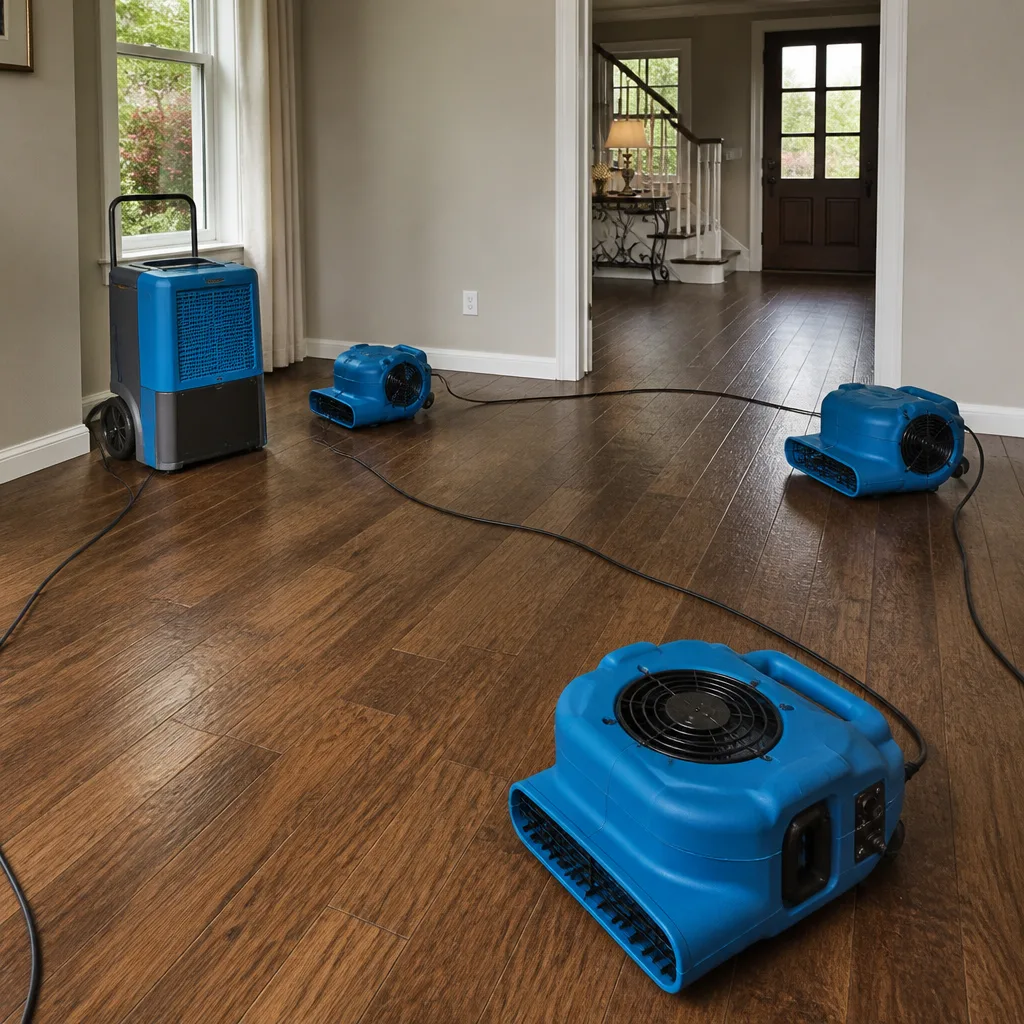
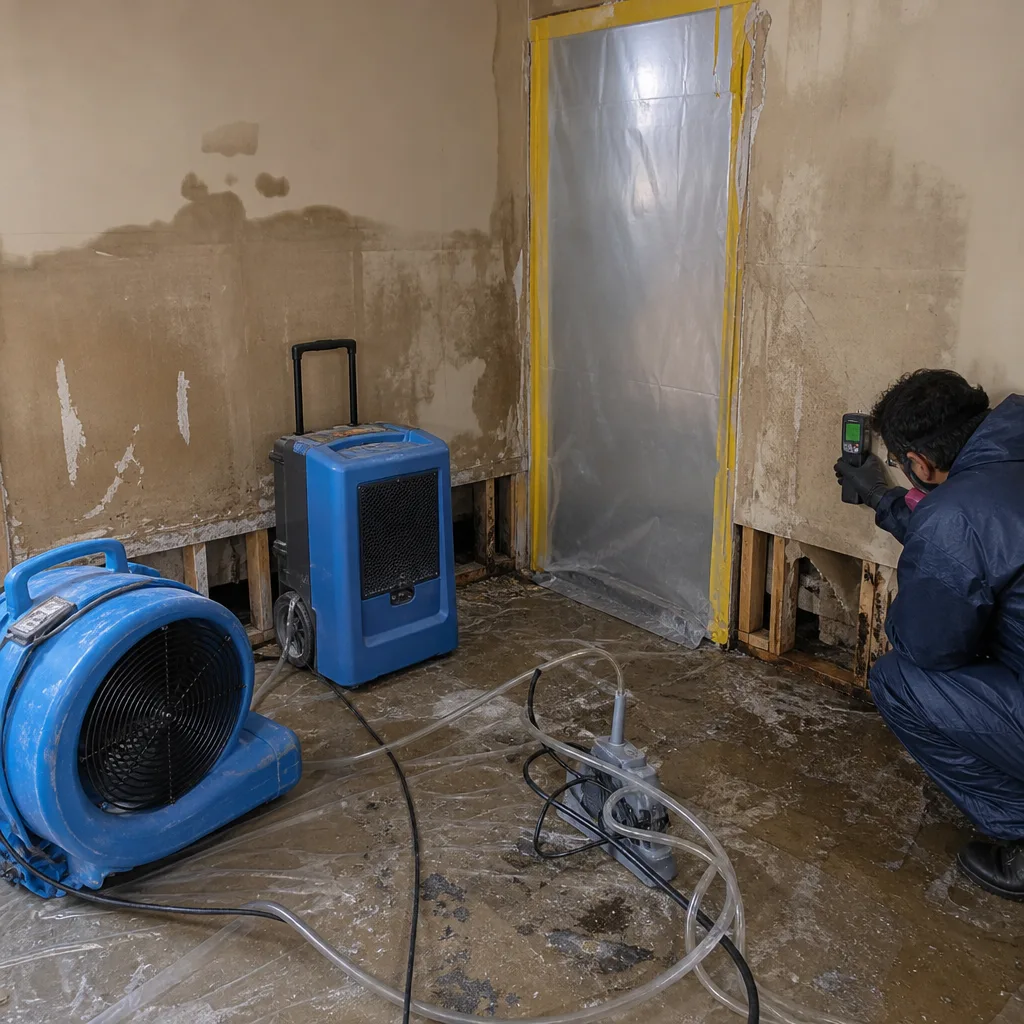
- Drying setup – Air movers and dehumidifiers are positioned based on room geometry, airflow calculations, and the specific materials affected. This is not a “set it and forget it” process. Proper drying requires monitoring moisture content daily with moisture meters and adjusting equipment placement based on readings.
- Daily monitoring and documentation – Professional restoration includes daily moisture readings that are recorded and shared with the property owner and insurance adjuster. The project isn’t “done” when the area looks dry. It’s done when moisture meters read at or below the dryness standard for the material type.
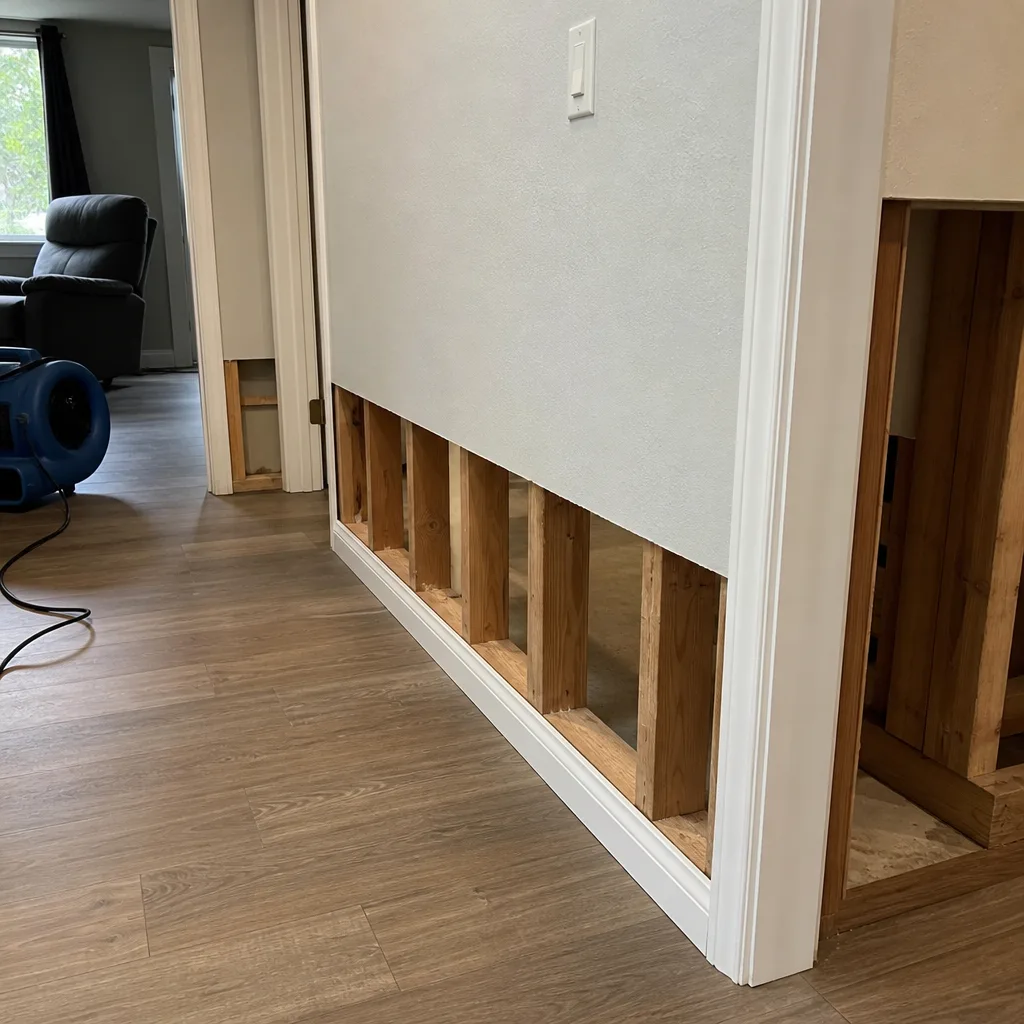
One thing that surprises Orange homeowners is how much demolition happens during this phase. Cutting out wet drywall isn’t a sign of incompetence. It’s the opposite. Drywall loses its structural integrity when saturated, and leaving it in place creates a mold farm inside your walls. A competent restoration crew knows what to pull and what can be dried in place, and that judgment call is where IICRC training separates specialists from general contractors.
How Orange’s Climate Shapes the Drying Process
Orange sits in a weird spot, meteorologically speaking. We get less than 15 inches of rain in a typical year, and most of it arrives in concentrated bursts between December and March. The rest of the year, our relative humidity hovers low enough that you’d think drying a wet house would be simple. And it often is. But those winter atmospheric river events change everything.
During a winter storm, the exterior air is saturated. Running conventional dehumidifiers in those conditions is like trying to dry a towel in a steam room. The equipment pulls moisture from the air, but the air keeps getting replenished with more moisture from outside. This is why professional restoration crews use LGR (low-grain refrigerant) dehumidifiers in Orange during the wet season. LGR units extract more water per kilowatt-hour than conventional dehumidifiers and continue working effectively at lower humidity levels. They’re the same technology used in commercial flood recovery, and they matter on residential jobs because they cut days off drying timelines.
During summer, the equation flips. Orange’s dry heat accelerates surface evaporation, which sounds good but creates a false sense of progress. Floors and walls can feel dry to the touch while hidden pockets of moisture remain trapped behind vapor barriers, under cabinets, and inside wall cavities. That’s why moisture meters and thermal imaging matter more than how the surface feels. We’ve seen hardwood floors in Orange read 18% moisture content while the surface felt completely dry because the subfloor below was still saturated against the slab.
The seasonal timing also affects equipment selection. In summer, fewer air movers may be needed because natural evaporation is faster. In winter, crews may need supplemental heat or desiccant dehumidifiers to maintain optimal drying conditions. A restoration company that uses the same equipment setup year-round in Orange is not accounting for the climate reality.
Slab-on-Grade Foundations: Why Orange Homes Dry Differently
Walk through any Orange neighborhood built between 1950 and 1980, and you’ll see the same construction pattern: concrete slab poured directly on grade, wood framing on top, stucco exterior. It’s the dominant building style in our city, and it creates a specific moisture problem that raised-foundation homes don’t have.
When water leaks onto a slab foundation, the concrete acts as a moisture reservoir. Concrete is porous. It absorbs water. If the slab was poured without an adequate vapor barrier underneath, or if the original vapor barrier has degraded over decades, groundwater and floodwater can migrate upward through the concrete and into flooring materials, baseboards, and the bottom plates of walls. This is called capillary action, and it’s the hidden enemy of slab foundation drying.
Here’s what that means for restoration protocol:
- Flooring removal decisions change. Vinyl plank or laminate over slab often traps moisture against the concrete, creating a micro-environment where mold can grow even after the surface appears dry. Professional crews in Orange typically pull affected flooring to inspect and dry the slab itself.
- Vapor barrier assessment becomes critical. If the slab lacks a functional vapor barrier, moisture readings may stay elevated for weeks even with aggressive drying. In these cases, restoration may require installing a new vapor barrier or using injection drying methods to remove moisture trapped under the slab.
- Wall bottom plates need special attention. The wood plate at the base of a wall sits directly on the slab. When the slab is wet, that plate wicks moisture upward. Left untreated, it becomes a mold food source and eventually rots. Water Damage Restoration in Orange crews routinely drill small test holes or use moisture probes at plate level to check what’s happening below the drywall.
- Drying timelines extend. Slab foundations hold water longer than raised subfloors. A room on a raised foundation might dry in 3-5 days. The same room on slab might take 7-10 days or longer depending on slab thickness, vapor barrier condition, and the amount of water absorbed.
Injectidry systems are particularly relevant here. These specialized panels and hoses inject warm, dry air into wall cavities and under flooring through small access points, drying the inside of the wall without tearing out all the drywall. For Orange slab homes, Injectidry technology often means the difference between cutting out just the bottom 2 feet of drywall versus gutting entire walls down to the studs.
Thermal Imaging and What Visual Inspection Misses
Human eyes are terrible at detecting moisture. By the time water damage is visible on a stucco wall, the damage has been progressing for days or weeks. That’s why professional restoration in Orange relies on FLIR thermal imaging cameras as a standard tool, not an optional upgrade.
Thermal imaging works by detecting temperature differentials. Wet materials hold temperature differently than dry materials. When a FLIR camera scans a wall, areas of trapped moisture appear as cool spots or thermal anomalies. The camera isn’t “seeing” water directly. It’s mapping thermal patterns that indicate where evaporation is occurring, and evaporation happens where moisture is present.
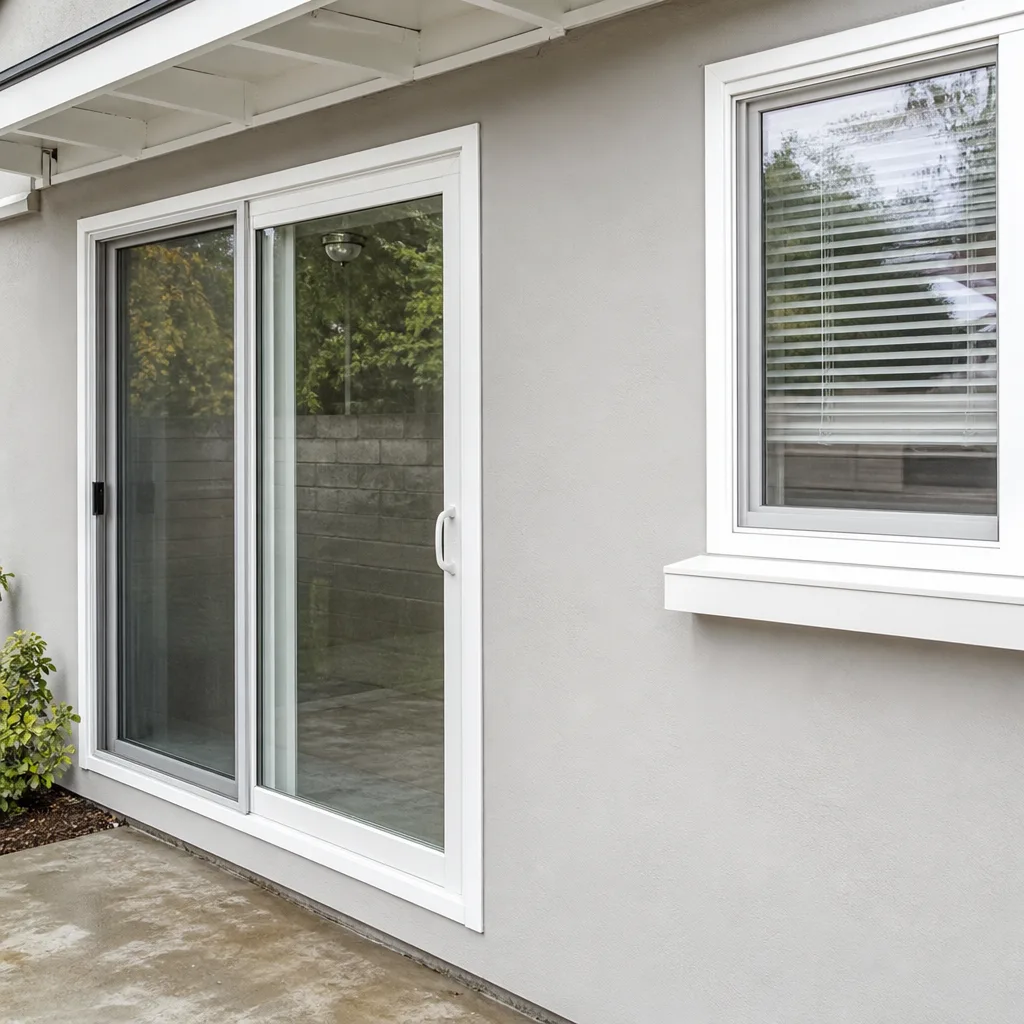
In Orange’s stucco homes, this matters enormously. Stucco is a great concealer. Water can penetrate through hairline cracks, work its way down the exterior wall, and pool behind the paper barrier without ever showing a stain on the interior drywall. By the time a homeowner notices a soft spot or discoloration, the wall cavity is often fully colonized with mold.
Thermal imaging changes the restoration workflow in three practical ways:
- It maps the full extent of water migration before demolition starts. Instead of cutting out drywall where the source is and hoping the damage stops there, crews can identify the true moisture boundary and set containment accordingly.
- It verifies drying completion objectively. At the end of the drying phase, a thermal scan can confirm there are no remaining cool spots indicating trapped moisture. This is stronger evidence than a visual check or a single moisture meter reading at one location.
- It creates documentation for insurance claims. Thermal images provide visual evidence of hidden damage that adjusters can see and understand. Without them, a homeowner is trying to convince an insurance company that invisible moisture exists. With them, the claim becomes a documented technical finding.
In our experience, thermal imaging is the single biggest gap between professional restoration and the handyman-with-a-wet-vac approach. Equipment matters. Training matters. And the ability to see what’s inside the wall without opening it changes everything about the scope of work.
Mold Remediation as a Distinct Second Phase
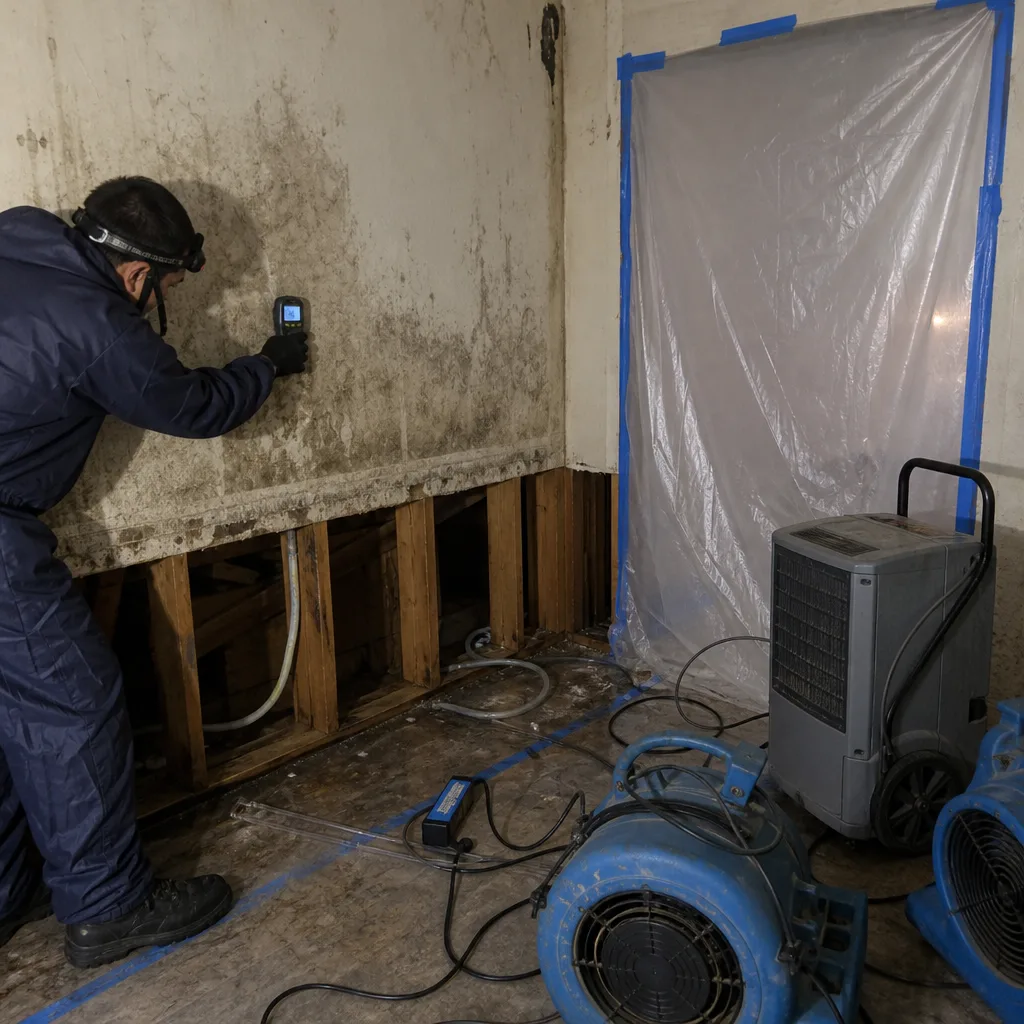
Mold remediation is not an extension of water damage restoration. It’s a separate discipline with its own standard (IICRC S520), its own containment protocols, and its own certification requirements. Treating it as a cleanup step rather than a remediation process is how small mold problems become building-wide contamination problems.
The S520 standard defines mold remediation in terms of containment levels. A small area of mold (less than 10 square feet) can sometimes be handled with local containment and HEPA vacuuming. Larger areas require full containment with negative air pressure, sealed doorways, and air scrubbing throughout the process. The goal isn’t to kill mold. It’s to remove it physically and prevent spores from spreading during removal.
What actually happens during professional Mold Remediation in Orange:
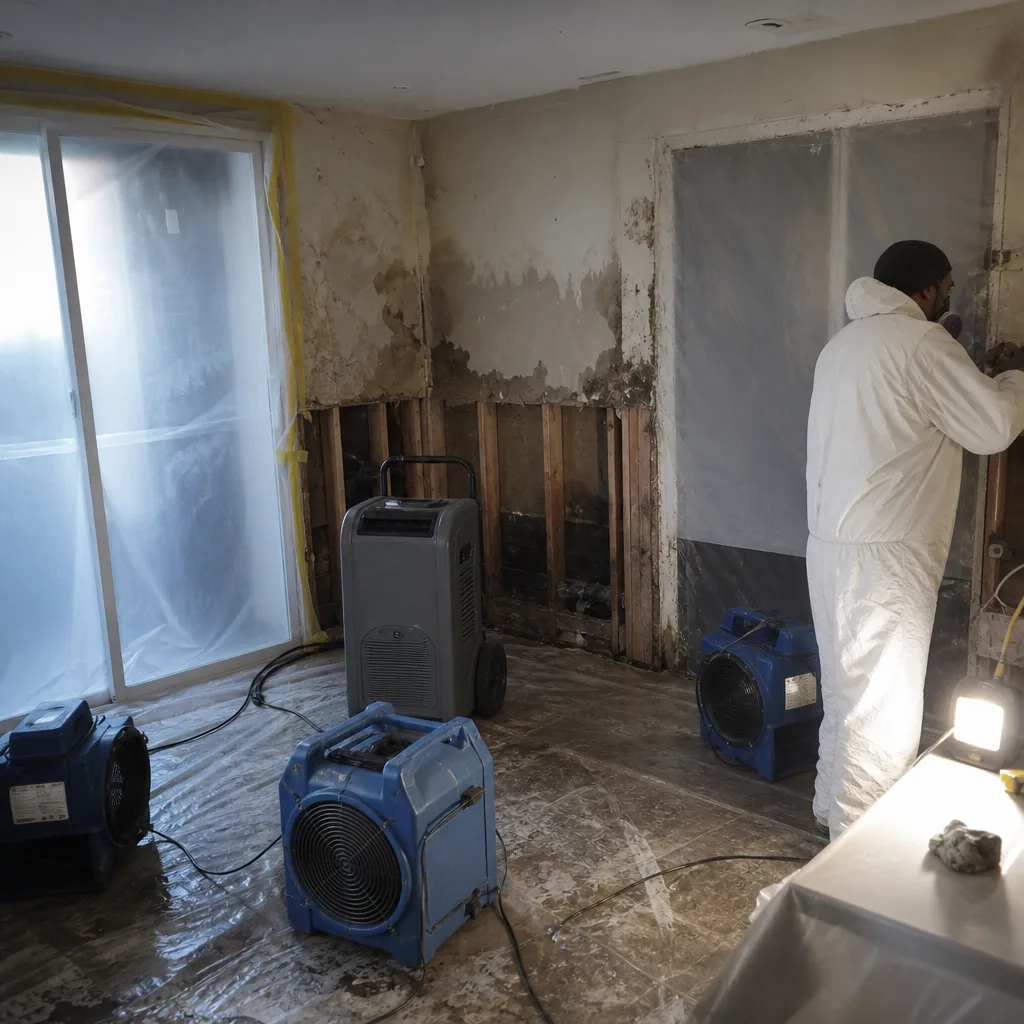
- Containment setup – The affected area is sealed with 6-mil polyethylene sheeting. Negative air machines create a pressure differential that keeps airborne spores from escaping into the rest of the house.
- HEPA air filtration – Air scrubbers with HEPA filters run continuously during remediation, capturing mold spores and other particulates. Units are sized to the room’s cubic footage, and the air in the containment area should be turned over multiple times per hour.
- Source removal – Moldy drywall, insulation, carpet, and other porous materials are removed and double-bagged for disposal. Non-porous surfaces like concrete and metal can often be cleaned with antimicrobial solutions and HEPA vacuuming. Porous materials that can’t be thoroughly cleaned are removed. That’s the standard.
- Post-remediation verification – After removal is complete, the area is HEPA-vacuumed, wiped down, and air scrubbed. A professional remediation should include post-remediation verification, which may involve surface sampling or air sampling to confirm spore counts have returned to normal background levels for the building.
- Board-up and structural securing – Fire often creates openings through the roof or walls. Emergency board-up prevents further weather damage and secures the property. This happens immediately after the fire department clears the structure.
- Soot and smoke residue assessment – Different types of fires create different types of residue. A protein fire (from cooking) leaves a thin, nearly invisible film that’s extremely difficult to clean. A synthetic materials fire leaves a thicker, greasier residue. The type of fire determines the cleaning chemistry and methods used.
- Deodorization – Smoke odor removal is not just about cleaning surfaces. It often requires hydroxyl generators or ozone treatment (in unoccupied spaces) to break down odor molecules that have penetrated porous materials. Thermal fogging may be used to replicate the smoke’s path and neutralize odor in wall cavities.
- Content cleaning and pack-out – Contents that can be cleaned and restored are packed out to a cleaning facility. This includes fabrics, clothing, and porous items that have absorbed smoke. Items that cannot be restored are documented for insurance claims.
- Initial loss documentation – Photographs, moisture readings, and thermal images taken before any work begins establish the baseline. This is the “before” evidence. If mitigation starts before documentation is complete, the insurance company can reasonably ask how they know what damage existed versus what was caused by the restoration process itself.
- Source identification – The insurance claim typically requires identification of what caused the damage and when. A documented source identification is part of the professional restoration report.
- Scope of work – What was torn out, what was dried in place, what equipment was placed where, and for how long. This is the daily log of restoration work. Professional crews maintain detailed job files with this information.
- Drying verification – Final moisture readings and thermal scans showing the structure has returned to dry standard. This closes the loop on the water damage portion of the claim.
- Reconstruction estimates – The repair scope is typically a separate estimate from the mitigation scope. Insurance adjusters review both, and they need to see that the repair scope is justified by the documented damage, not inflated beyond it.
- Waiting to see if the area dries on its own. In Orange’s slab foundations, water trapped under flooring or inside wall cavities doesn’t dry on its own within the 72-hour mold window. The clock is running, and waiting costs money.
- Using a conventional dehumidifier for a major water loss. A consumer-grade unit may pull a pint or two per day. A commercial LGR from Dri-Eaz or Phoenix pulls gallons per hour. The time difference is measured in days or weeks, and every day of wet materials increases mold risk.
- Assuming visible water equals total damage. Water travels horizontally through wall cavities and under flooring. What you see on the surface is almost never the full extent. Thermal imaging finds what you’re missing.
- Pulling drywall without containment for mold. If mold is present, demolition without proper negative air containment spreads spores throughout the house. A small mold patch becomes a whole-house contamination event in hours.
- Treating all water as clean water. Water from a toilet overflow, a washing machine that’s flushed dirty laundry, or a sewage backup is Category 2 or 3 water. It requires different handling, and the affected materials may require removal rather than drying.
- Skipping the vapor barrier check on slab homes. If the slab lacks a functional vapor barrier, moisture will keep migrating upward through the concrete no matter how many air movers are running. The vapor barrier is the underlying issue that must be addressed.
- Assuming the insurance company will pay for everything. Insurance policies have limits, exclusions, and depreciation schedules. A professional restoration company can help document the loss properly, but the policy terms are what they are. Understanding coverage early prevents surprise bills at the end.
Orange homeowners should understand that mold doesn’t start growing the day after a leak. It starts growing within 48-72 hours under the right conditions. By the time mold is visible, the colonization has been active for at least a week. The visible mold is almost always a fraction of what’s actually present, because the interior of the wall cavity is where moisture accumulates and airflow is lowest. This is why professional remediation focuses on containment and removal protocols rather than simply wiping down surfaces.
Fire and Smoke Restoration: A Different Restoration Track
Fire damage restoration operates on a completely different set of priorities than water damage. That seems obvious, but the practical implications for Orange homeowners are worth spelling out. Water follows gravity and wicks upward. Smoke follows airflow and pressure differentials. A small kitchen fire can deposit soot and odor throughout an entire house because the HVAC system distributed particles through the ductwork.
The Fire Damage Restoration in Orange process includes several phases that don’t exist in water restoration:
Fire restoration also intersects with water restoration. The water used to extinguish the fire causes its own damage. A fire that destroys the kitchen also floods the floor below. Professional fire restoration handles both: water extraction and drying where needed, and soot and odor removal where needed. The two processes run in parallel, not sequentially.
In Orange, where homes are often close together and built with shared walls in newer developments, fire containment matters for neighbors too. Smoke can travel through shared attics and wall cavities. A proper fire restoration assessment checks adjacent spaces, not just the room where the fire occurred.
Insurance Documentation and the Timeline Connection
Insurance companies don’t just need to know that damage occurred. They need to know what the damage looked like at each phase of restoration, what was done about it, and why each step was necessary. Gaps in documentation are where legitimate claims get denied or reduced.
Here’s how the restoration timeline connects to the insurance documentation requirements, and why a professional restoration company in Orange manages them as one integrated process:
In Orange, where many homes are 50-70 years old, insurance documentation also needs to account for pre-existing conditions. If a wall had old water staining from a prior leak, that needs to be distinguished from the current damage. Professional restoration documentation does this with dated photographs and moisture readings taken at the time of the loss.
We’ve worked with Orange homeowners who tried to handle water damage themselves, submitted a claim weeks later, and found the insurance company questioning whether the damage was as severe as reported. The absence of professional documentation created doubt. The presence of a documented professional restoration creates a paper trail that protects the claim from start to finish.
Common Mistakes to Avoid
When to Call a Professional
Call a professional restoration company in Orange when water damage covers more than a small area you can dry with towels and a fan. Call when the water has penetrated walls, flooring, or cabinetry. Call when mold is visible or a musty odor persists after a leak. Call when smoke has traveled through the HVAC system, even if the fire was small. Call when the water source is a sewage backup or floodwater, because contamination risks exceed DIY scope. Call when you’re filing an insurance claim and need documentation that will hold up to scrutiny.
Renew Water Damage offers free estimates in Orange. We hold IICRC certification and maintain membership in the RIA and IFA. Our crews use commercial-grade equipment including Dri-Eaz and Phoenix dehumidifiers, XPOWER air movers, and Injectidry cavity drying systems. Call (833) 620-3891 for a professional assessment, or learn more about our process at the Renew Water Damage home page.
Frequently Asked Questions
Water extraction and drying typically takes 5-14 days in Orange, depending on the extent of water migration, the materials affected, and whether the slab foundation requires extended drying time. Mold remediation adds another 2-7 days depending on containment and removal scope. Full restoration including reconstruction typically runs 2-6 weeks from initial damage to finished repairs. Fire restoration varies more widely based on structural damage and content cleaning needs. Call (833) 620-3891 for a timeline specific to your property.
Water damage restoration in Orange typically ranges from $3,000-$8,000 for a contained single-room loss with drying, $8,000-$20,000 for multi-room water damage requiring demolition of drywall and flooring, and $20,000-$50,000 or more for whole-house water damage affecting structural framing or slab foundations. Mold remediation adds $2,000-$10,000 depending on containment level and affected area. Fire restoration is highly variable. The biggest cost driver is how long water sat before professional treatment began. Estimates are free at Renew Water Damage, call (833) 620-3891.
Most Orange homeowners insurance policies cover sudden and accidental water damage from events like pipe bursts, appliance failures, and storm-related roof leaks. Coverage typically excludes gradual water damage (long-term leaks), flood damage from rising water, and mold remediation if the mold results from a covered water loss that was not mitigated promptly. Homeowners must document the damage and mitigation steps from day one. Professional restoration documentation from an IICRC-certified company strengthens the claim. Contact your insurance agent for specific policy terms.
Water damage restoration focuses on removing water and drying the structure to prevent mold from forming. Mold remediation removes mold that has already colonized. They are separate processes governed by separate IICRC standards (S500 for water damage, S520 for mold). Restoration companies that do both under one roof provide continuity, because the water damage crew’s drying decisions affect whether mold develops and where.
Most water damage restoration work in Orange can be completed while you stay in the home, though the affected area will be sealed off and noisy air movers will run continuously. Mold remediation involving large-area containment typically requires you to stay out of the contained area but you can often remain in other parts of the house. Fire restoration with odor treatment may require temporary relocation, especially if hydroxyl generators or ozone equipment is in use. Your restoration company can advise based on the specific scope.
Shut off the water source if you can identify it, turn off electricity to the affected area if water has reached outlets or appliances, move valuables and furniture out of standing water, and call a professional restoration company in Orange. Take photos of the damage before removing anything. Don’t use a regular vacuum to remove water, and don’t run HVAC if the system may have drawn in water or smoke. The crew can provide further instructions when they arrive. Renew Water Damage is available at (833) 620-3891.
The Bottom Line
Damage restoration in Orange is not a single event. It’s a multi-phase technical process governed by industry standards and shaped by our specific climate and construction. Slab foundations and stucco exteriors hide water and mold in ways that raised-foundation homes don’t. Professional restoration uses thermal imaging to find what visual inspection misses, commercial LGR dehumidifiers to dry materials on schedule, and documented moisture readings to prove the job is done. The first 72 hours determine whether you’re facing a drying project or a mold remediation project. The right team on day one changes the entire outcome.
Written by the team at Renew Water Damage, serving Orange since 2015.
See the difference
 Before
 After
 Before
 After
 Before
 After