Water Damage Restoration Pricing Breakdown: What Orange Homeowners Pay in 2026
Water damage restoration in Orange runs between $3.75 and $7.50 per square foot for a standard Category 1 clean-water mitigation in 2026, meaning a typical 200-square-foot kitchen flood lands between $750 and $1,500 for drying and cleanup. That number climbs fast when the water is contaminated, the response is delayed, or hidden cavities need specialized drying. The real story isn’t the headline number though. It’s what drives it. If you’d rather skip the math and get a straight answer for your house, call (833) 620-3891 for a free estimate.
Here’s the part most homeowners miss: every line item on a water damage invoice maps to a specific equipment day-rate, labor tier, or disposal cost. Those rates follow industry pricing databases like Xactimate, the same software your insurance adjuster uses. Once you understand the structure, you can spot padding before you sign anything.
The One Factor That Controls Your Final Bill More Than the Flood Itself
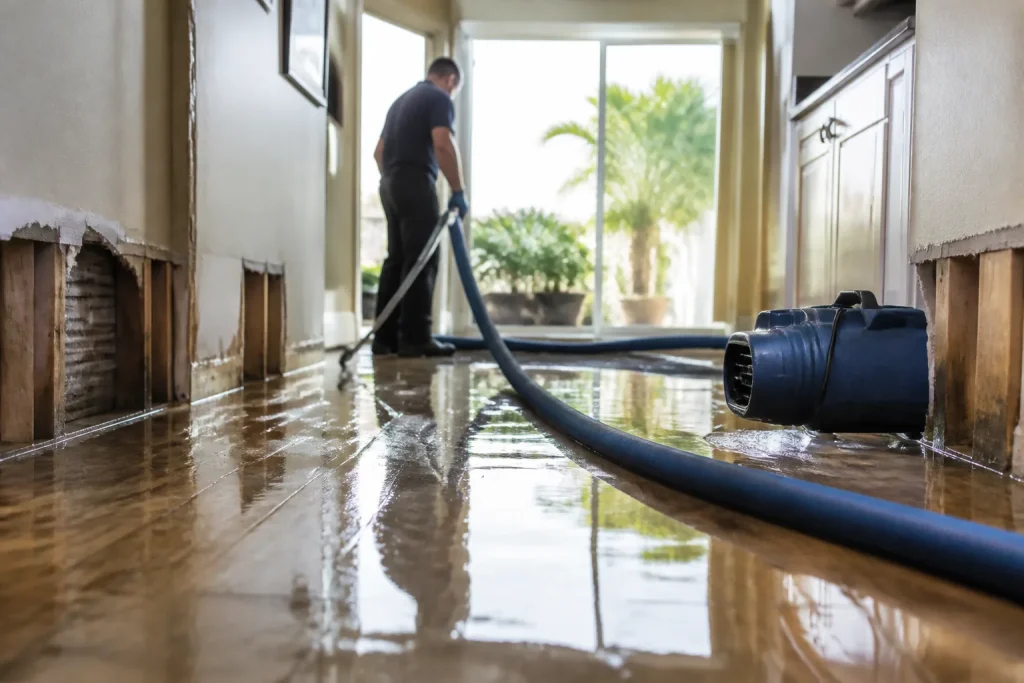
The single biggest cost driver in Orange water damage restoration isn’t how much water came in. It’s how many days the drying equipment sits in your house. And that number is almost entirely controlled by how fast the first crew responded.
Think of it this way: a burst supply line caught within two hours means extraction, equipment set up, maybe four to five days of drying. A slow leak that’s been weeping behind a wall for three weeks means drywall is saturated through, baseboards are swelling, the subfloor is wicking moisture, and the mold clock has been ticking since day three. Same house, same pipe, wildly different invoice.
Timeline matters more than most people realize:
- Hour 0 – 24: Standing water is extracted, equipment goes in. Affected area is typically contained to the original spill zone. Cost is at its lowest.
- Day 2 – 4: Water has migrated into wall cavities and under flooring. The affected square footage has effectively expanded. Drying takes longer, equipment count goes up.
- Day 5 and beyond: Secondary damage becomes primary damage. Swelling, delamination, mold colonization. Now you’re paying for removal, not just drying. Cost multiplies.
We’ve pulled equipment out of homes in Orange neighborhoods like Fairhaven and El Modena where a homeowner waited a week hoping a fan would handle it. The fan just circulated moist air. The drywall wicked it. The bill tripled compared to what a same-day response would have cost.
Line-by-Line: What a Typical Orange Residential Claim Actually Lists
This is the part competitors rarely show you. A standard water damage restoration in Orange invoice breaks down into predictable categories. If you see charges that don’t fit one of these buckets, ask questions.
2026 Xactimate benchmark ranges for Orange, CA:
- Water extraction: $0.75 – $1.25 per square foot for standing water removal using truck-mounted or portable extraction units. A 200-square-foot area runs $150 – $250.
- LGR dehumidifier: $85 – $125 per day, per unit. Low-grain refrigerant units from brands like Dri-Eaz and Phoenix are the standard. Most residential jobs need one or two units running 3 – 7 days.
- Air movers: $35 – $55 per day, per unit. Expect one air mover per 75 – 100 square feet of affected area. That’s 3 – 4 units for a typical kitchen flood.
- Antimicrobial application: $0.30 – $0.65 per square foot. This is the biocide treatment applied to affected surfaces to prevent mold colonization. Required on Category 2 and 3 losses, recommended on Category 1.
- Disposal and debris removal: $150 – $450 for a typical residential load depending on volume, weight, and Orange municipal disposal fees.
- Daily monitoring visits: $75 – $150 per visit. Technicians check moisture readings with penetrating and non-penetrating meters, rotate equipment positions, and document drying progress.
Add those up for a 200-square-foot kitchen with a supply line break and you’re looking at roughly $1,100 – $1,500 in mitigation costs before any rebuild work starts. The reconstruction invoice is separate, which we’ll get to shortly.
Categories Change Everything: Why a Toilet Overflow Costs 5x a Pipe Burst
Water damage is classified by contamination level under IICRC S500 standards. The category determines required protective measures, disposal rules, and whether materials can be dried in place or must be cut out entirely.
The three categories, and what they mean for your wallet:
- Category 1 (clean water): Supply line breaks, faucet overflows, rain through an open window. Materials can typically be dried in place using standard equipment and methods. Base cost applies with minimal demolition.
- Category 2 (gray water): Washing machine discharge, dishwasher overflow, shower drain backups. Contains biological or chemical contaminants. Requires antimicrobial treatment, controlled disposal, and often some selective demolition of porous materials like carpet pad or unsealed drywall. Cost runs 2 – 3x a Category 1 loss of equal size.
- Category 3 (black water): Sewage backup, toilet overflow past the trap, floodwater from outside. Heavily contaminated with pathogens. Porous materials are removed, not dried. Full PPE for crews, special waste handling, containment barriers. Cost runs 3 – 5x a Category 1 loss. Same square footage, completely different scope.
We’ve seen Orange homeowners try to gut a Category 3 basement in short sleeves and a hardware-store mask. Don’t. The bacteria load in sewage water isn’t worth gambling on, and your insurance company will pay for professional remediation more readily than for a hospital visit. If you’re uncertain which category you’re dealing with, call us and we’ll walk you through it.
Mitigation vs. Reconstruction: Two Scopes, Two Contracts, and the Overbilling Trap
Here’s where Orange homeowners routinely get confused, and where less scrupulous operators make their margins. A water damage claim has two distinct phases, and they should almost never be handled by the same contractor under a single vague invoice.
Mitigation is the emergency work: extraction, drying, dehumidification, antimicrobial treatment, removal of unsalvageable materials. This is what stops the damage from spreading. It’s priced using Xactimate line items like the ones above.
Reconstruction is the rebuilding work: drywall replacement, flooring installation, painting, finish carpentry. This is remodelling work. It’s quoted as a construction bid, and it’s handled by a general contractor or a full-service restoration firm running a separate reconstruction division.
The overbilling trap to watch for:
- Double-billed demolition: You get charged for “removal of wet drywall” on the mitigation invoice, then “demo and haul-away” again on the reconstruction invoice. Same wall, charged twice.
- Overlapping supervision: A project manager fee on the mitigation side and a separate “job oversight” line on the reconstruction bid when one person did both.
- Equipment left running late: Dehumidifiers and air movers billed for days after the drying logs show the structure hit its dry standard. Ask to see the moisture readings. Any legitimate firm tracks them daily.
One certified team from water extraction through final restoration eliminates the coordination gaps and the double-billing risk. That’s how we work at Renew Water Damage, with mitigation and reconstruction under one roof so the left hand knows what the right hand already charged.
Insurance in Orange: What Your Policy Actually Pays For
Your insurance adjuster will recognize the same Xactimate pricing structure we’ve walked through here. That’s not a coincidence. Most carriers in California use it as their benchmark database. What matters for you is which part of the bill flows through your policy and which part comes out of pocket.
Typically covered under a standard HO-3 policy:
- Water extraction and emergency mitigation
- Equipment drying costs (dehumidifiers, air movers)
- Antimicrobial treatment and containment
- Removal and disposal of water-damaged materials
- Direct repair or replacement of damaged building materials up to policy limits
Frequently out of pocket or partially covered:
- Source repair: the plumber who fixes the broken pipe is usually your cost, not the restoration company’s
- Slow leaks with no sudden event: many policies require “sudden and accidental” damage and exclude long-term seepage
- Mold remediation beyond policy sub-limits: most California policies cap mold coverage at $3,000 – $10,000 regardless of your dwelling limit
- Additional Living Expense (ALE): covered if your home is uninhabitable, but subject to percentage limits and time caps. Some ALE covers hotel, some covers meals, some covers both. Read the declarations page.
Before you ever file a claim, pull your declarations page and look for three numbers: your dwelling limit, your mold sub-limit, and your ALE limit. If you’re confused about what you’re reading, call us. We deal with adjusters daily and we’ll help you understand what’s covered before the work starts. Photo documentation of every stage is non-negotiable, and we handle that too.
Why Drying Technology Matters to the Bottom Line
Equipment quality isn’t a marketing point. It’s a line item on your invoice and a variable in how long the job runs. Entry-level rental units and big-box-store fans move air. LGR dehumidifiers and high-velocity air movers actually change the vapor pressure balance so moisture releases from materials.
The difference shows up on jobs where water has migrated into wall cavities or under tile. That’s where Injectidry systems earn their keep. They create negative air pressure inside wall and subfloor cavities, pulling trapped moisture out through the existing structure. Traditional drying would require cutting holes or removing flooring. Injectidry often means the cabinet stays on the wall and the tile stays down. Fewer demolition costs, shorter reconstruction time, lower final invoice.
We run Dri-Eaz and Phoenix dehumidifiers and XPOWER air movers on Orange residential jobs, the same equipment used on commercial warehouse losses. The equipment matters because incomplete drying is the gift that keeps on giving: the invoice looks cheap on day five and then the mold blooms on day thirty and you’re paying for mold remediation in Orange on top of everything else.
When to Call a Pro
If the water migrated farther than you can see, if it seeped under cabinets or into walls, or if the leak ran for more than 24 hours before you caught it, call before you start tearing things out. What looks dry at the surface is often still wet underneath, and the moisture readings are what determine whether the structure is actually dry or just looks like it. We’ve walked into Orange homes where a homeowner had run box fans for four days, the drywall felt dry to the touch, and the meter read 28% moisture content at the base plate. That’s mold territory. The fans just hadn’t hurt anything yet.
Related services in Orange: Water Damage Restoration in Orange | Mold Remediation in Orange | Fire Damage Restoration in Orange
The Bottom Line
Water damage restoration pricing in Orange is predictable once you understand the structure. Extraction runs about a dollar per square foot. Equipment runs $35 – $125 per unit per day. Category determines whether materials get dried or demolished. Response speed determines whether the affected area is 200 square feet or 600. And the mitigation invoice should always be separate from reconstruction. That structure is your best protection against overbilling.
If you’re in Orange and dealing with water damage, even if it looks minor, get it assessed before it turns into a mold problem. Renew Water Damage offers free estimates and we’ll show you the moisture readings, not just talk at you. Call (833) 620-3891 and we’ll get a certified technician to your house fast, with commercial-grade equipment and an honest breakdown of what needs to happen and what it’ll cost.
Frequently Asked Questions
Expect $3.75 – $7.50 per square foot for Category 1 clean-water mitigation in Orange during 2026. That includes extraction, equipment drying, and antimicrobial treatment. Category 2 runs 2 – 3x that base range, and Category 3 sewage losses run 3 – 5x due to demolition, contamination controls, and higher disposal costs. For an exact quote on your property, call (833) 620-3891.
Most HO-3 policies cover sudden and accidental water damage, including mitigation, drying, and repair of damaged materials. Mold remediation is typically capped by a sub-limit of $3,000 – $10,000 regardless of your main dwelling limit. Long-term seepage or gradual leaks are frequently excluded. Check your declarations page for your specific limits, and call us if you need help interpreting them.
Typical residential drying takes 3 – 7 days for Category 1 losses with proper equipment, assuming response within 24 hours. Category 3 losses involving sewage or exterior floodwater add demolition time and typically run 7 – 14 days for mitigation alone. Reconstruction after drying is a separate timeline, anywhere from one to four weeks depending on scope. The faster the first response, the shorter the total project.
A household fan and consumer dehumidifier won’t handle water that’s migrated into wall cavities or under flooring. You’ll dry the surface, not the structure, and the moisture trapped inside becomes a mold source within days. If the water spread beyond what you can see or ran longer than 24 hours, get moisture readings from a professional. It’s a quicker and cheaper fix than remediation after the fact.
Written by the team at Renew Water Damage, serving Orange since 2015.
Need Damage Restoration Help?
Call Renew Water Damage — licensed & insured, here with fast after-hours help in Orange.
(833) 620-3891