
Emergency Water Damage Restoration Near Me: What Orange Homeowners Should Do First
If you’re standing in an inch of water right now, here’s the short version: shut off the water source, cut power to affected rooms at the breaker panel, call a restoration company before your insurance company, and start documenting everything with your phone. Those four moves in the first thirty minutes will do more to protect your home and your claim than anything else you’ll do all week. If you’d rather not manage this yourself, call (833) 620-3891 and we’ll walk you through it while a crew heads your way.
We pulled a sopping wet sectional out of a house near Old Towne Orange last month where the homeowner had spent forty minutes on hold with their insurance carrier before calling anyone else. By the time we got there, water had migrated through the subfloor into two adjacent rooms. That’s not a criticism of the homeowner. It’s a criticism of every generic “what to do after a flood” checklist that puts insurance first. The order matters. Here’s what actually works.
The 30-Minute Window: A Timed Sequence That Actually Protects Your Orange Home
Water damage in Orange County homes follows predictable physics. Water wicks up drywall, travels through subfloor channels, and evaporates into the air. The humid air then moves through open doorways faster than the water itself. In our experience, homeowners who act in the first half hour consistently face remediation scopes 30 to 50 percent smaller than those who wait. The sequence below is what we’d do in our own homes.
Minutes 0 – 5: Stop the Source and Kill the Power
- Shut off the water source. If it’s a burst supply line, close the nearest fixture valve or the main shutoff at the street. If it’s an appliance, disconnect it or close its dedicated valve. Don’t assume the leak stopped just because the floor looks stable.
- Cut power to affected areas at the breaker panel. Water and energized circuits don’t mix. Flip the breakers for any room with standing water or soaked walls, even if the lights still work. If the panel itself is wet or you have to stand in water to reach it, don’t touch it. Call an electrician first.
- Close interior doors to unaffected rooms. This is the step almost nobody does, and it’s one of the most important. Humid air travels faster than water. Closing doors contains the moisture load and keeps your living room from becoming a secondary drying zone.
Minutes 5 – 15: Document Before You Move Anything
Your phone camera is now your most valuable claims tool. Before you start moving furniture or mopping, photograph everything where it sits. Adjusters and restoration crews need to see the original state of the loss, not a cleaned-up version.
Here’s what actually helps a claim, based on what we’ve watched adjusters review over the years:
- Stand back first. Get a wide shot of the whole room so the scope is visually obvious: where the water starts, where it stops, what’s wet and what isn’t.
- Put a measurement reference in frame. A tape measure, a dollar bill, even your hand next to the water line gives scale. Without it, an adjuster can argue the water line was higher or lower than you say.
- Shoot material connections. Baseboards, door casings, the bottom edge of drywall, the seam where wall meets floor. These are the first places water hides and the places where material identification matters for the estimate.
- Take a photo of the water source itself. The pipe, the appliance connection, the roof penetration. This often becomes the cause-and-origin reference later.
- Turn on photo timestamps. Most phone cameras can embed a timestamp in the image metadata or a visible watermark. Turn this on. It anchors your timeline.
Once you’ve documented, then start elevating wood furniture legs onto blocks or saucers, pulling up area rugs at the edges, and moving salvageable items to dry rooms. But don’t start ripping out wet carpet yourself. That’s a job for a crew that’s going to take moisture readings and document the scope before demolition begins.
Why Calling Your Insurance Company First Is Usually the Wrong Order
Here’s the thing nobody tells you about water damage claims in Orange: insurance carriers are not first responders. They’re claim processors. When you call them first, you spend twenty minutes on hold, then another fifteen answering questions from a representative who may not have restoration training, and then they tell you to call a restoration company anyway. Meanwhile, water is still moving through your floor assembly.
The better sequence is this: stop the water, cut the power, call the restoration contractor, and then notify your carrier. A good restoration company will document the loss in a way that slides straight into your claim file. We photograph everything, map moisture, and produce written scope documents that adjusters can actually use. We’ve had adjusters in Orange tell us the single most useful thing a homeowner can do is get a restoration pro on site fast enough to document pre-mitigation conditions.
So the order of operations for Orange homeowners: control what you can control, get a certified crew en route, then make the insurance call. Your claim is stronger because the documentation is better.
When we arrive at a water loss in Orange neighborhoods like El Modena or the Plaza district, the first thing our water damage restoration crews do is map the moisture boundary. We’re not guessing with a hand wave. We’re using thermal imaging and moisture meters to find exactly where the water went, because water always goes farther than the visible wet spot. That mapped boundary becomes the scope, and the scope becomes the claim. The earlier that map is drawn, the more accurate everyone’s picture is.
What to Tell the Dispatcher So the Crew Brings the Right Equipment
Restoration is not a one-truck-fits-all situation. The equipment payload for a clean water supply line burst is different from the payload for a sewage backup or a roof leak that’s been running for three days. When you call a restoration company in Orange, the dispatcher is trying to figure out what to load on hand. Help them.
Here’s a simple script. If you tell us these five things, we’ll arrive correctly equipped:
- Where is the water coming from? Supply line, appliance, sewage, rain intrusion. Each source changes the category of water, and category changes the protocol.
- How long has it been running? An hour is different from a weekend. Hours matter for saturation depth and mold risk.
- What rooms are affected and what floor surfaces are involved? Tile on slab, hardwood, carpet over subfloor. The drying plan is heavily material-dependent.
- Is there standing water, or is it soaked-in moisture? Standing water needs extraction. Soaked-in moisture needs cavity drying. Different machines, different crew setup.
- Can you safely access the breaker panel? This tells us whether the electrical systems are safe to work around or whether we need to coordinate an electrical isolation first.
The local pros deploy Dri-Eaz and Phoenix dehumidifiers plus XPOWER and B-Air air movers on Orange residential jobs. That’s the same equipment class used for large commercial losses. But equipment without the right payload decisions on dispatch day is just a truck full of machines. The information you give the dispatcher determines whether we show up ready to extract, to dry cavities, or to set up a full containment.
The Hidden Cost of DIY Water Extraction with a Wet-Vac
We understand the impulse. A wet-vac from the garage feels like the fastest available response, and Orange homeowners are practical people. But there’s a structural problem with surface extraction, and it’s one we see almost weekly in homes from Villa Park to the Santiago Creek area.
When you run a wet-vac over carpet or a hard floor, you’re pulling water off the surface. What you’re not pulling is the water that has already soaked into the pad, the subfloor, the bottom plates of the walls, and the wall cavities themselves. The surface dries enough to feel okay, but you’ve now created a contained humidity environment: trapped moisture inside building materials with a dry surface layer acting as a cap. That’s exactly the condition mold colonization loves. We’ve opened walls in Orange homes where a homeowner’s thorough wet-vac job left a perfect wet-layer sandwich that turned into active growth inside four days.
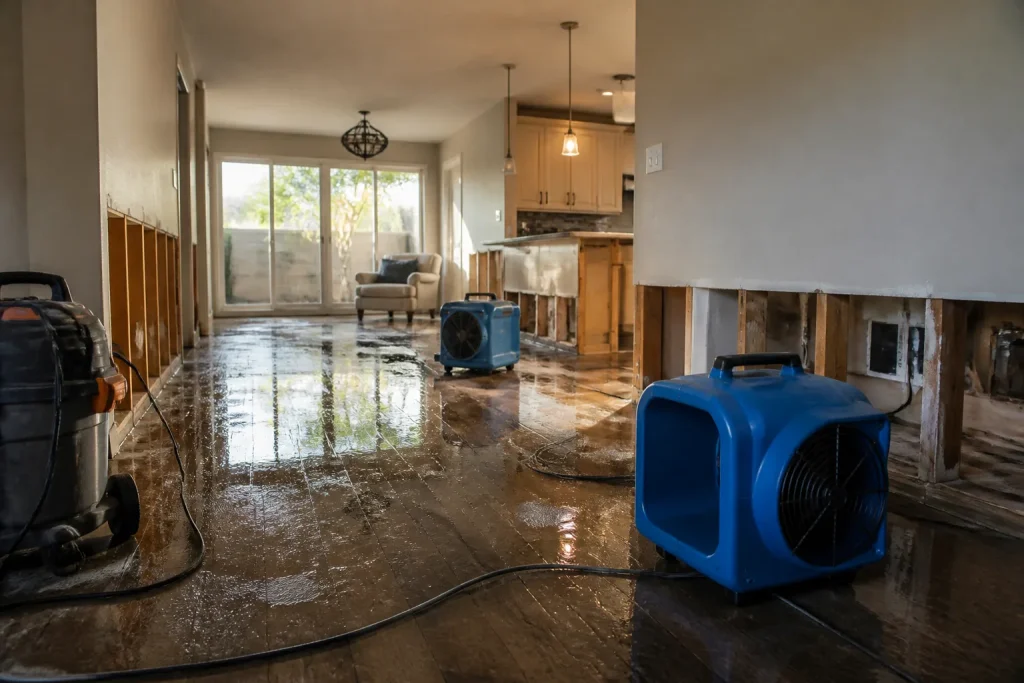
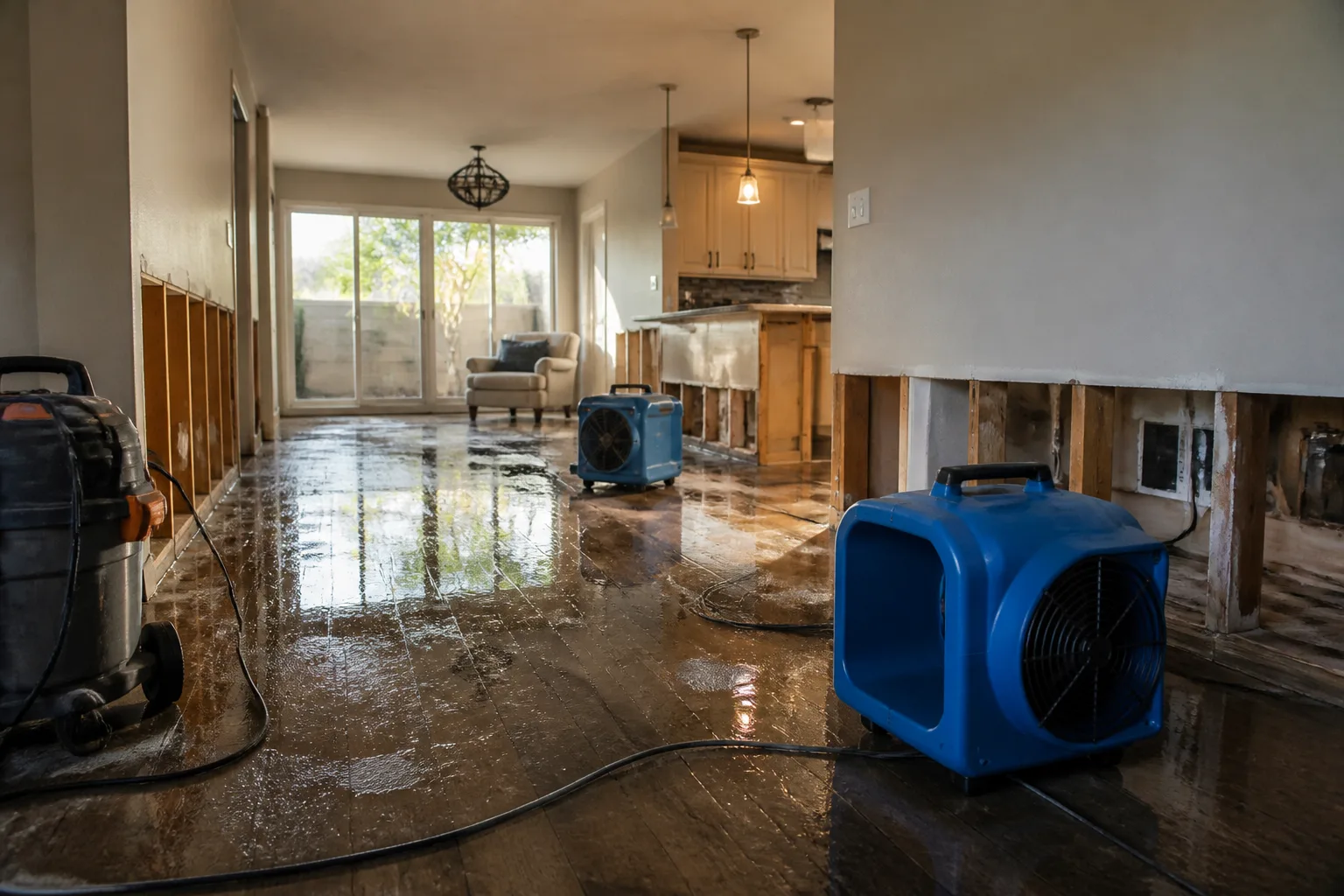
IICRC-certified technicians follow documented drying protocols. That means we don’t clean up visible water and call it done. We measure the moisture content of materials, calculate the drying load, and set up systems that address trapped water, not just surface water. A big part of that is Injectidry wall-cavity drying. The Injectidry system applies controlled suction to wall and subfloor cavities, pulling moisture out of enclosed spaces that surface air movers can’t reach. That allows us to dry many structural cavities without tearing out drywall or flooring unnecessarily.
Surface drying without cavity drying is the most expensive shortcut in this business. It’s not the wet-vac that costs you. It’s the reconstruction you’ll need later when the trapped moisture finally shows up as staining, warping, or mold. If you’re already committed to the wet-vac, use it to keep the visible water from spreading while a professional crew is on the way. Just don’t mistake it for remediation.
When to Call a Pro (and What “Certified” Actually Means in Orange)
If any of the following are true, this is not a weekend project:
- The water came through or above the first floor. This means cavities, insulation, and structural connections are involved.
- The water is gray or black (from appliances, sewage, or outdoor runoff). This requires containment and controlled disposal, not just drying.
- You can’t see the edges of the wet area. If you don’t know where the water stops, you can’t know what’s actually damaged.
- It’s been more than 24 hours. Mold risk rises sharply after the first day, and the drying scope changes.
- You smell something that wasn’t there before the leak. Musty or sour smells mean biological activity has already started.
When we say the local pros are IICRC-certified, here’s what that means in practice. IICRC is the restoration industry’s most recognized credentialing body, and its certification process trains technicians to documented, peer-reviewed standards. That means the person holding the moisture meter at your house has been tested on the science behind drying dynamics, not just on equipment operation. We also hold membership with the Restoration Industry Association and IFA, which means we’re subject to ongoing professional standards beyond our initial certification. You can verify all of this. That’s the point. Anyone can print “water damage experts” on a truck. Fewer can show credentials that mean something.
The Bottom Line
Water damage in Orange County homes follows known physics. The first thirty minutes determine how big this gets. Shut off the source, kill the power to wet areas, close interior doors to contain humidity spread, document everything with your phone before you move a single item, and call a certified restoration crew before you call your insurance company. The order of those steps is the difference between a contained mitigation and a full reconstruction.
If you’re in Orange and dealing with water damage right now, Renew Water Damage offers free estimates. Call (833) 620-3891 and you’ll talk to someone who can tell you what to do next, whether or not you decide to work with us. We’d rather help you limit the damage over the phone for free than show up to a much bigger loss because you didn’t call until day three.
Related services in Orange: Mold Remediation in Orange | Fire Damage Restoration in Orange | Renew Water Damage home
Frequently Asked Questions
We dispatch crews to Orange locations as quickly as traffic and call volume allow, and we’ll give you a realistic window when you call. The important thing is to start the documentation and containment steps while you wait. Call (833) 620-3891 to get on the schedule and get specific guidance for your situation.
Coverage depends on your policy and the source of the water. Sudden and accidental events, like a burst supply line, are typically covered. Long-term seepage or lack of maintenance is often not. Photo documentation of the source and the scope of affected materials strengthens your claim regardless. We’ll help you document everything in adjuster-compatible form.
If the water affected structural materials (walls, subfloor, baseboards) or has been present for more than 24 hours, surface cleaning won’t address trapped moisture. That trapped moisture drives mold growth behind walls. A professional assessment with moisture meters will tell you whether you’re looking at a surface cleanup or true remediation. In Orange, where humidity compounds drying challenges, we recommend professional assessment for anything beyond a small, contained spill addressed immediately.
We coordinate directly with adjusters, and we provide photos, moisture maps, and written scope documents in the format they expect. That doesn’t mean we’re intervening on your policy. It means we give you clean documentation that supports your claim, so you’re not trying to translate technical drying data into layperson terms on a phone call. Call (833) 620-3891 for specifics on how that works in Orange.
Written by the team at Renew Water Damage, serving Orange.
Need Damage Restoration Help?
Call Renew Water Damage - licensed & insured, here with fast after-hours help in Orange.
(833) 620-3891