How to Choose the Right Damage Restoration Company in Orange
Choosing a damage restoration company in Orange comes down to verifying three things before you sign anything: the credentials of the technician who will actually show up, the equipment that company owns and deploys, and the documentation they produce during the job. Most homeowners check none of these. They call whoever answers fastest, then discover two weeks later that the drying was inadequate and mold has set in behind the baseboards. If you’d rather skip the research and just talk to someone who does this every day, call Renew Water Damage at (833) 620-3891 for a free estimate.
Any contractor can rent a dehumidifier. The question that separates restoration specialists from opportunists is: “What grain depression are you targeting for my specific building materials?” If they can’t answer it, they’re guessing at your drying timeline. Here’s how to filter the real specialists from the rest before you let anyone touch your property.
The Four Credential Checks That Actually Matter
The company owner might hold every certification in the book, but that doesn’t help you if the two-person crew they send to your house in Orange has never opened a psychrometric chart. Ask specifically about the technician who will be on site.
- WRT certification on the job-site technician. Water Restoration Technician certification from IICRC means the person holding the moisture meter has been trained to documented standards, not trained by watching YouTube videos. Ask for the tech’s name and verify their credential. A company that hesitates to tell you which technician is coming and what certifications they hold is telling you something useful.
- IICRC firm certification. This is separate from individual certification. A firm certification means the company’s processes, not just one person’s training, meet IICRC standards. Renew Water Damage holds IICRC certification at both levels, and the local pros follow the S500 water damage and S520 mold remediation standards as a matter of daily practice.
- Active California contractor’s license. Verify it yourself on the CSLB website. Don’t take a license number printed on a business card at face value. In Orange specifically, we’ve seen post-storm subcontractors borrow license numbers from companies they don’t work for. Thirty seconds on the CSLB lookup will tell you who you’re actually dealing with.
- General liability plus pollution liability coverage. Restoration work disturbs mold spores, sewage bacteria, and fire soot. General liability alone doesn’t cover a botched mold remediation that cross-contaminates the rest of the house. Pollution liability is the specific policy that does. If you’re in Orange and a company can’t name their pollution liability carrier, keep looking.
Why Equipment Inventory Matters More Than Company Size
A company with fifty vans and rented dehumidifiers from Home Depot will underperform a two-person crew with a commercial drying arsenal. The equipment is the methodology. You can’t hide behind marketing when the truck doors open.
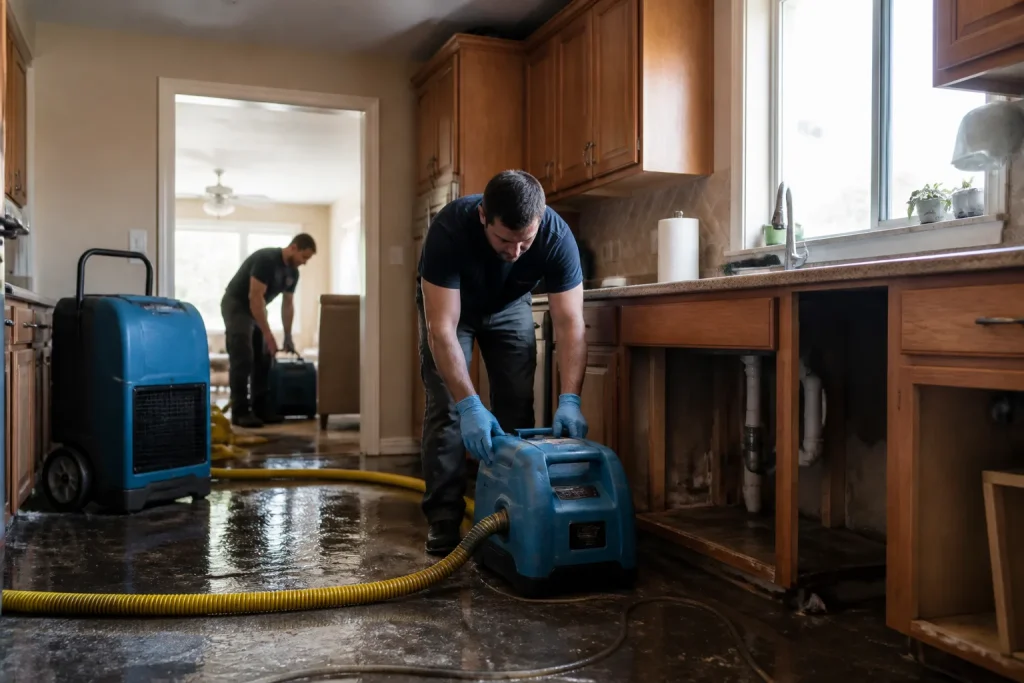
Before you hire anyone in Orange, ask for an equipment manifest for your specific job. A legitimate drying crew arrives with:
- LGR dehumidifiers (low-grain refrigerant units like Dri-Eaz and Phoenix) that pull moisture from air at atmospheric humidity levels where standard dehumidifiers stop working effectively.
- High-volume air movers (XPOWER and B-Air are the units we run) positioned for calculated airflow across wet surfaces, not just aimed randomly at puddles.
- HEPA air scrubbers to filter airborne particulates during mold remediation and sewage cleanup.
- Thermal imaging and penetrating moisture meters to find water that’s trapped where a visual inspection can’t see it.
One piece of equipment worth asking about by name: Injectidry wall-cavity drying systems. These run negative air pressure through sealed wall cavities to dry moisture trapped inside wall and floor assemblies without tearing out drywall. In Orange homes built in the 1960s and 70s with plaster over lathe, this is often the difference between a three-day dry-down and a three-week demolition-and-rebuild. A company that doesn’t own Injectidry systems will tend to recommend demolition more often, because it’s the only option they have.
We dry what others miss, including inside walls and subfloors, with Injectidry cavity systems. It’s not a sales pitch. It’s the reason our drying logs show completion in days, not weeks.
Red Flags Unique to Orange’s Post-Storm Contractor Surge
Orange doesn’t get hurricanes, but atmospheric river events and the occasional burst pipe winters send a wave of out-of-town “restoration” companies through Orange County every year. Homeowners in Orange should watch for three specific patterns.
Storm chasers appear within 48 hours of a major weather event, work from out-of-state plates, and disappear before the drywall is fully dry. They leave behind half-finished jobs and no local address where you can find them six weeks later when the musty smell returns.
Unsolicited door-knocking is the second tell. Reputable restoration companies in Orange are busy after a storm. They don’t need to wander neighborhoods looking for work. If someone knocks on your door within a day of water damage and offers a “free inspection” with a sense of urgency, they’re selling something, not helping.
Assignment of Benefits (AOB) forms are the third and most serious red flag. An AOB signs your insurance benefits over to the contractor, letting them bill your insurer directly and negotiate the claim on your behalf. It sounds convenient. In practice, it removes you from the process and has been widely abused in California. Legitimate companies bill you or your insurer with your involvement intact. If a company in Orange asks you to sign an AOB before they’ve even assessed the damage, decline and call someone else.
Ask to See a Sample Moisture Log Before You Sign
This is the single fastest filter in the industry. A professional water damage restoration job produces a documentation trail: daily moisture readings from specific locations, temperature and humidity readings, and a psychrometric log that tracks drying progress against calculated targets. These are standards defined in IICRC S500.
Ask any company you’re considering in Orange this: “Can you show me a moisture log and psychrometric report from a past job?”
A specialist will say yes immediately. We keep redacted copies of past drying logs ready to show for exactly this reason. The data shows you what happened, day by day, and proves the company measures what they’re doing rather than guessing at it.
A generalist will stall, deflect, or say something vague about “industry standards” without producing paperwork. That answer is your answer. If they’ve never produced a psychrometric log, they’ve never run a documented drying job. In our experience, the contractors in Orange who can’t show logs are the same ones whose jobs develop odor complaints three months later.
A related documentation question: ask how they’ll prove the job is dry before they pack up. The answer should involve moisture readings on site, not a technician’s thumb against the wall.
Specialist vs. General Contractor: Why the Order Matters
Here’s a mistake we see regularly in Orange: a homeowner calls a general contractor first because they want “one company to handle everything.” The GC says sure, then spends three days lining up a plumber and a drying crew while water wicks up the drywall and into the subfloor. By the time mitigation starts, primary water damage has become secondary damage: mold, delaminating cabinets, swelling baseboards, warped flooring.
The correct order is mitigation first, reconstruction second. A restoration specialist extracts water and begins drying within hours. Once the property is dry and documented, a general contractor steps in for rebuilds, drywall, paint, and finishes. The two are different disciplines serving different phases.
This is why Water Damage Restoration in Orange should be your first call, not your last. We handle water extraction, structural drying, and documentation. We can recommend rebuild contractors in Orange when the drying is done, but the critical first 48 hours belongs to mitigation, not construction planning.
One certified team from water extraction through final restoration. That’s the standard. If a company can’t describe how they’ll produce that first psychrometric reading within hours of arrival, they’re not a restoration company. They’re a remodeling company that owns a wet-vac.
We pulled one out of a garage over in the Old Towne Orange district last month where a homeowner had hired a “full-service” contractor the day before. The contractor had set up two box fans and a rented dehumidifier from a local hardware store, pointed them at a carpet pad that was already two days wet, and told the homeowner to “give it a few days.” The moisture reading behind the baseboard was 42%. The mold was already starting. We had to tear out thirty percent more drywall than we would have if mitigation had started when the pipe burst. Speed on extraction, not on signing a construction contract.
When to Call a Pro
Water damage is not a DIY situation once it moves beyond a small spill. If the water affected walls, flooring, or subflooring, or if the leak was ongoing for more than a few hours, call a professional. The risks are structural (compromised subfloors, warped framing), biological (mold, bacteria from Category 2 or 3 water), and financial (delayed claims are routinely denied or reduced).
For mold, the same logic applies. If you can see mold on more than about ten square feet of surface, disturbing it without proper containment will spread spores throughout the house. Mold Remediation in Orange is a containment-and-removal process governed by IICRC S520 standards, not a bleach-and-scrub job.
And for fire: smoke residue is acidic and corrosive. It etches glass, corrodes metal finishes, and embeds in fabrics and drywall. Professional Fire Damage Restoration in Orange uses chemical sponges, HEPA vacuuming, and ozone or hydroxyl treatment to remove odor and residue rather than painting over it. Waiting to call a pro means the damage compounds.
The Bottom Line
Choosing a restoration company in Orange isn’t about who has the best website or the biggest ad budget. It’s about four things you can verify in an afternoon: the technician’s WRT certification, the company’s IICRC firm status and insurance coverage, the equipment on their manifest, and their willingness to show you a drying log from a past job. Companies that pass all four tests are rare. Companies that pass them smoothly are the ones you want.
Renew Water Damage is an IICRC-certified firm operating in Orange with commercial-grade Dri-Eaz, Phoenix, XPOWER, B-Air, and Injectidry equipment on every job. We handle water, mold, and fire restoration as a complete system, not as an add-on service. If you’re in Orange and facing water intrusion, mold discovery, or fire aftermath, call (833) 620-3891 for a free estimate. We’ll put a certified technician on site and produce the documentation to prove the job was done right.
Restoration built on industry standards, not contractor shortcuts. That’s the whole point. See our Renew Water Damage home page for more on how we work.
Frequently Asked Questions
Ask for the name of the technician who will be on your job, then verify their WRT certification through IICRC. Ask for the company’s IICRC firm certification separately. In Orange, any company doing restoration work should also hold an active California contractor’s license you can check on the CSLB website, plus general liability and pollution liability insurance. If they can’t show all of these, they’re not a certified restoration company regardless of what their website says.
A professional drying setup in Orange includes LGR dehumidifiers (Dri-Eaz or Phoenix are industry standards), high-volume air movers (XPOWER, B-Air), HEPA air scrubbers, thermal imaging cameras, and penetrating moisture meters. For water trapped inside wall cavities or subfloors, ask if they have Injectidry wall-cavity drying systems. A company that shows up with box fans and a rental dehumidifier is not running a professional drying job.
Within hours, not days. In Orange’s climate, warm temperatures accelerate mold growth and secondary damage. IICRC S500 standards call for extraction and drying to begin as soon as practically possible after the water event. Every 24-hour delay increases the likelihood of mold growth, delamination, and structural deterioration. A company that can’t dispatch a crew until next week isn’t a restoration company, they’re a construction company with a side hustle.
In most cases, homeowner’s insurance covers sudden and accidental water damage, like a burst pipe or an appliance failure. Gradual leaks and lack of maintenance are often excluded. The key is documentation: photos, a written scope of work, and daily drying logs all strengthen your claim. Companies that provide photo-documented assessments and coordinate directly with your adjuster make the process significantly smoother. For a free estimate and insurance-ready documentation, call (833) 620-3891.
Written by the team at Renew Water Damage, serving Orange.
Need Damage Restoration Help?
Call Renew Water Damage - licensed & insured, here with fast after-hours help in Orange.
(833) 620-3891